The innovation
Definition of innovation: everything that lets mankind advance forward.
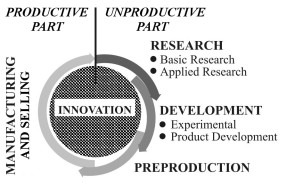
Two phases of innovation are distinguished:
1. productive phase
2. unproductive phase
The productive phase includes production and distribution of goods.
The unproductive phase consists of three parts:
1. research
2. development
3. production of test series or preparation for series production
|
|
|
Each element of
productive phase is known, it contains information and knowledge available for anybody (e.g. utilization of certain machines and technologies, their procurement, transfer of technology, etc.). Every investment made in
unproductive phase is validated in the
productive phase of innovation.
Since it is impossible to forecast what
solutions can emerge from the research/development/test series production, that will require new solutions of industrial property protection, preferably every element of the
unproductive phase has to be handled confidetially. The work and money invested in the
unproductive phase will be realized in the
productive phase, when somebody purchases the product.
1.
Research may be
basic or
applied research. A solution/procedure that may be patented is created in the
research phase relatively infrequently. In addition, the initiation of a patent procedure has to be given thorough consideration owing to the fact that the solutions arrived at in this phase are easily circumvented.
2.
Development may be
a) experimental or
b) product development.
a)
Experimental development is needed when the result of some research is not foreseen in its entirety, or it is hard to specify the extent to which research results can be exploited in practice. In other words, research (laboratory) results have to be confirmed by experiments of an industrial character. In the course of
experimental development, it is determined whether the research result
- can be directly applied in practice, or
- needs to be modified, or
- is not suitable for application in practice.
b)
Product development begins when the research result makes such development possible. Furthermore, product development is carried out when upgrading of an existing product/procedure is required and no or only limited research activity is needed.
3.
Preproduction
Preparation for serial production following the development phase.
Protection of industrial property - patenting
Submission of a patent application should be postponed as much as possible. This is important because a need for modification may arise during research, development, and preproduction, negatively affecting the patent protection of the product/procedure. It does not appear reasonable to submit a patent application during the research phase. According to the common practice, patent applications are submitted
- when the product is ready for serial production, or
- at the time of commencement of serial production, or
- before the beginning of distribution.
The third option is applied when the innovation and/or patent application can be circumvented relatively easily. The manufacturer/patent holder bases his advantage on flooding the market and the announcement of patent protection (e.g., toys, consumer goods, etc.).
It is not likely that each result of the research/development should be patented, as this would result with the subject or solution becoming public.
Keeping a result of research/development activity in secret may sometimes generate more benefit than a patent.